The Severe storm visualization seemed to have the purpose only to show the uneducated (about storms) viewer a storm system in a way that they could comprehend. This is different from the molecular visualizations made by Jane Richardson, which presented the information in a way so that the educated (about molecules) viewer could quickly understand what the characteristics of the molecule he/she was looking at are, and then use it as data for other purposes, or even modify it to make it a more accurate representation of the molecule it is representing.
While the earlier storm visualization was successful in helping the viewer understand how a storm works and looks, that was all it could do. Nowadays, visualizations, like the molecule visualizations shown by Richardson, can be open source and easily modifiable to portray whatever data the user gives it. They also act as system to portray data you are working on. Richardson demonstrated this when she corrected, in real-time, a molecule that had certain proteins incorrectly positioned. She saw some proteins were incorrectly positioned through a visualization system, and then used that same visualization system to fix the molecule.
The storm visualization did have some problems that detracted from its ability to demonstrate storms to the viewer. For example, the rainbow spectrum the reflectivity was mapped to is not perceived by our eyes, in term of realizing linear change, as well as white to black, or white to red color maps. Also, the scale on the visualization was misleading--the height of the storm had by enhanced so that it didn't fit the units of the grid in the usual way. And the storm visualization used high contrast on things less important in the image, rather than only saving the high contrast for things that were very important the user focus on. In the screen shots or the remade version, these things were corrected. As a result, the information about the storm being visualized was much easier to perceive and comprehend.
Tuesday, February 24, 2009

Wednesday, February 18, 2009
Comments on: Margaret S. Livingstone's Lecture
I thought this keynote address was very interesting. Linvingstone does a great job showing that vision is information processing, not information transmission through the use of illusions that in actuality do not look how we visualize them. For example, the picture on the upper left here is a great example of this. Staring at one square, the intersection at the corners of every other square looks like it contains a gray dot. However, in reality the picture has no grey dots, it is just a mistake being made by our visual system transferring the information on the computer screen into our brains.
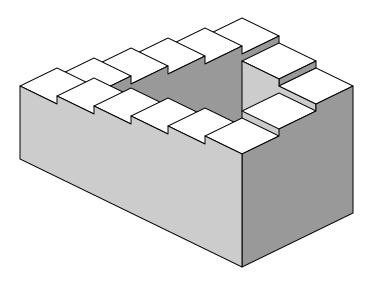
I also found it very interesting how you can have impossible figures. When the local depth cues are all fine, even if the laws of physics are defied, your brain interprets the information it receives to be alright. For example, this image shows a staircase that could never exist in real life. However, our brain only sees the small parts of the image our eyes are focused on, and as long as those look ok, the brain assumes the whole image is ok. Becuase our vision only checks exactly where we are looking rather than the whole image, the image as a whole can be impossible but be perceived as ok by the brain.

I also found it very interesting how you can have impossible figures. When the local depth cues are all fine, even if the laws of physics are defied, your brain interprets the information it receives to be alright. For example, this image shows a staircase that could never exist in real life. However, our brain only sees the small parts of the image our eyes are focused on, and as long as those look ok, the brain assumes the whole image is ok. Becuase our vision only checks exactly where we are looking rather than the whole image, the image as a whole can be impossible but be perceived as ok by the brain.
Thursday, February 12, 2009
Comments on: Cherryl Broverman's Lecture and Women's Empowerment through Information Technology
I thought Broverman's lecture did a great job of presenting the interesting fact that even while Kenya is a very poor country, many males Kenyans have access to (almost) modern day technology. While most villages don't have running water or bathrooms, they do have internet cafes, and many males Kenyans have cell phones. However, Broverman, as well as the articles, also presented the idea that impoverished women in the countries of Africa don't have any education, gender equality, or access to technology. Ms. Broverman talked about how the WISER initiative is hoping to change this by directly bringing technology to women in Africa, to allow them to learn about AIDS and general health, the politics of their countries, women's rights movements throughout the world, or anything else they can find on the net. In this way, WISER's goal is to educate these women despite a culture that says women are meant to be wives and houseworkers.
Kiva.com, talked about during the lecture, also seems very interesting. It seems like a great way of helping people in Africa make big steps in their lives, while only having to contribute a small amount of money. This is becuase the level of wealth is so much different in the US than in Africa that a little american money is a lot of African value. To me, it seems more like community service to donate this money -- I don't know how many people really want a return on their loans instead of just to help someone in need.
I also thought Broverman's description of the ISIS 200 capstone project was very interesting. The students of this class are working on creating a toolkit to map pictures and places, and people's lives to system sort of like Google Earth, where the region can be explored on the macro level as a map and icons representing picture and events can be clicked on. Its very cool to see students from North Carolina are working to solve a problem half way across the world. I would very much like to see the finished product and how it is actually put to use to analyze different cultural aspects of Africa.
WISER Website Review
After reviewing the WISER website, I have come to some conclusions about its mission and the way it will go about fulfilling this mission. I think WISER's mission to "break the cycle of early marriage, HIV, and poverty" in Nyanza is a very important mission that could greatly help the citizens of Nyanza, and maybe eventually all of Africa. At the same time, the way to fulfill this mission could prove difficult. In an idealistic world, I think it is a great idea to open a school specifically for young women to educate them about micro-finance, technology, health, and politics. However, I think in reality it will be harder than this. For one, becuase of the masculine domination that currently exists in Nyanza, a lot of these girls' fathers will make there daughters stay home and do chores rather than (in their eyes) waste their time at a school for all girls, which, becuase of culture, the Nyanzian men would probably consider a joke. Also, even with 70% scholarships, that means 30% of students would have to find their own way to raise the money (perhaps with Kiva.com). In a country this impoverished, I think it would be hard for the girls to find the money to go to this school. For these reasons, I think WISER's idea is good, but I am skeptical of how well it will play out in reality.
SLURL Reviews
Interesting SLURLS (Visited by me and Dianhao Luo):
Visit Mexico (http://slurl.com/secondlife/Visit%20Mexico/132/60/62) - This island is a historical depiction of the Mayan Temples in Mexico. You can explore the Mayan temples, walk through the rain forest, or even take a zipline ride through the forest. It was really cool to explore, but there wasn't really anyone else here to talk to.
The Free Dove (http://slurl.com/secondlife/Gallii/113/53/33) - This island offers free accessories such as jewelry, hats, shoes, and tattoos to new players with no money. There was lots of free stuff to get and try on, and a bunch of new players were there to meet. This island was very welcoming towards new players, and seemed designed to appeal to new players via free stuff.
777 League (http://slurl.com/secondlife/2raw/117/92/22) - This island contains a community for virtual racing that includes one of the longest, most elaborate racing tracks in Second Life. They also have tons of really cool looking cars to buy (if you have the money, that is). While this island is open, you can't really participate unless you pay the 777 League around $10 US to buy a car. Without a car, you can watch, but not drive.
Tuesday, February 10, 2009
Information Science, Medicine, and Mr. Olson's Lecture
This weeks articles and Mr. Olson's lecture on the intersection of information science and medicine were very interesting. I think it's very cool how robots are being created to slowly but surely take the place of humans, such as Da vinci, a robot that allows surgeon's to more precisely and from anywhere in the world do surgery, Penelope, a robotic nurse, and, Dr. McSleepy, a robotic anesthesiologist who can interpret data on human blood-gas levels much quicker and more accurately than humans can. The question is, however, as we are able to assign these robots more and more tasks regarding surgery and health, should we? There is something very important in the difference between humans and robots -- we have the ability to think on our feet. For example, if something doesn't go as planned (or according to the algorithm in the case of a robot), a robot could just sit there and watch the person die becuase it doesn't have code on what to do in this new situation. However, a human has actual knowledge, rather than only directions, and so can imply what to do in those kinds of situations. There are also other issues regarding the dependability of "surgeon" robots. They could malfunction or physically break mid-surgery, for example. Also, I'm sure these robots use a huge amount of electricity to power themselves. If a natural disaster were to occur, many people would need hospital treatment, and there is a high likelihood that the power would go out so these robots wouldn't work. This means that during the times we need surgeons, nurses, ect. the most (when many people are injured at once), these robots would be unable to do their task. This would make natural disasters much worse, becuase all hospitals relying on these robots would be out of commission. Don't get me wrong, I do think the technology is useful. But becuase we are dealing with something as delicate as human life, I think this technology needs to be an additional tool of surgeons, not a replacement for them.
Tuesday, February 3, 2009
Comments on: Patrick Herron's Lecture
I thought today's lecture by Patrick Herron on Serious Games was very interesting. Not only did he clear up the irony I stated about Virtual Heroes by saying that they are looking to apply their technology to peaceful, not warlike, things, but he also defined simulation and how it is being used in the real world. He discussed flight simulators, network simulators, weather simulators, MMORPGs as simulations, and even the real world as a simulation. I really liked his point about how the real world could just be a simulation, like in the Matrix, and in reality we are simply "brains in the vat." Thinking of the real world as a possible simulation makes it even clearer how useful simulations can be. He even talked about how we learn faster through imitating/doing rather than simply being instructed on how to do something, and how becuase of this, using simulations lead to faster learning.
Subscribe to:
Posts (Atom)