I thought Mr. Furey's talk on the uses and implications of genotyping and mapping the human genome was very interesting. From his lectures, I learned about the various businesses that you can pay to genotype you to say your probability of contracting certain diseases or conditions. However, right now it seems that tracing your family's history is a more effective (and much cheaper) way to determine your susceptibility to diseases. One thing I found particularly interesting was the issue of who owns your DNA. I cannot believe that some companies are actually patenting part of my DNA sequence. According to Wikitionary, a patent is a "declaration issued by a government agency declaring someone the inventor of a new invention and having the privilege of stopping others from making, using or selling the claimed invention." Under this definition, its very hard to believe that governments actually let people patent our DNA. These people did not "invent" the DNA in are bodies, it is natural. They were just the first people to try to claim rights to it. The idea of patenting DNA and holding sole rights to "its use" is like the idea of patenting an eagle and holding sole rights to how people may want to use an eagle. It is a part of nature, not some man-made object. Now, I could understand if they wanted to patent a way to read a DNA sequence or a medicine meant to help a condition caused by a DNA sequence, because a company could invent those solutions. But the idea of a company having the sole rights to anything done with a certain DNA strand is preposterous--the company doesn't own it, it is in the "public domain" of nature, and every individual has their own copy.
Another interesting issue was about what rights people have to be protected from discrimination based on DNA. One law, the Genetic Information Non-Discrimination Act, makes it illegal for insurance companies to deny insurance based on genetics, and employers to deny employment based on genetics. However, going in to the future, is this really something we can enforce? For one, companies could simply say they are firing you because of another reason, when in reality it is because of your DNA. Also, eventually it could become very easy and fast to read and genotype DNA, and companies could secretly test you to determine if they want to hire you or fire you. Its next to impossible to hide your DNA. People lose hair and skin cells naturally every day. All a company would have to do is find a stray hair or bodily fluid and then they could see exactly what your strengths and weaknesses are, as dictated by your DNA. Another issue around this is the question of is hiring on the basis of genes actually bad? Really, your DNA is just a bodily resume of your strengths and weaknesses as a human, and companies choose on the basis of resumes, and strengths and weaknesses, all the time. Companies are always looking to hire the best person for the job. Wouldn't a paper resume and DNA test be the best determiner of how affect you could be at your job? Also, should people who apply for jobs that could be dangerous to people with certain genetic conditions have to be tested for those genetic conditions? Not only would these people be ineffective at their job, but they may get very hurt by doing it. For example, should construction workers be tested for genetic signs that would say how likely they are to have a heart attack under physical stress? Yes, DNA testing as part of a job application seems like an invasion of privacy, but don't we, as determined individuals, want the best for our companies so we can provide the best products and services? And don't we want to make sure no one could put themselves in harms way by doing a certain job? DNA testing would allow us to make sure we are hiring healthy and effective people, just as the required resume, physical examination, and health disclosure forms do in today's workplace.
Thursday, April 16, 2009

Tuesday, April 7, 2009
SL Commercial Enterprise: 777 League
777 League (http://slurl.com/secondlife/2raw/117/92/22) - This island contains a community for virtual racing that includes one of the longest, most elaborate racing tracks in Second Life. They also have tons of really cool looking cars you can view in the showroom. This business allows you to look at the cars in the showroom and watch races for free, but in order to participate, you must pay $10 to buy a car, and a small fee to partake in a race. The company also comes out with new "updated" models of many cars over time, so people are inclined to keep purchasing the newer cars because they might look cooler or have better stats. The island also has a club for racers to hangout in, and a biker club for bike racers. The clubs are free to enter and free to attend events.
The target customer of this business is people who enjoy watching races, car-afficianatos, and people who enjoy racing video games, because this business revolves around creating a pay-to-play version of "Need for Speed" or other racing games in Second Life. Racing games are very popular on computer and video game consoles, so they will probably also be popular on Second Life. Also, because this island has one of the longest, most elaborate racing tracks in Second Life, as well as many live performances at its clubs, it is a unique combination of large scale racing, lounging, socializing, and dancing. The live performances attract people to the island, and while there, they see all the racing stuff the 777 club has to offer which makes them want to buy a car and race too.
The target customer of this business is people who enjoy watching races, car-afficianatos, and people who enjoy racing video games, because this business revolves around creating a pay-to-play version of "Need for Speed" or other racing games in Second Life. Racing games are very popular on computer and video game consoles, so they will probably also be popular on Second Life. Also, because this island has one of the longest, most elaborate racing tracks in Second Life, as well as many live performances at its clubs, it is a unique combination of large scale racing, lounging, socializing, and dancing. The live performances attract people to the island, and while there, they see all the racing stuff the 777 club has to offer which makes them want to buy a car and race too.
Sunday, April 5, 2009
Comments on Smith and Jenkins Lectures:
After hearing what Mr. Smith and Ms. Jenkins have to say about intellectual property and copyright law, I have come to the conclusion that copyright laws are so strict toward protecting the rights of current intellectual property owners that digital creativity is being stifled in the rest of us. Because IP owners have so much control over where their content is used, copied, and extended upon, most people are afraid to be creative for the fear that they will infringe on content someone has already copyrighted. Because so many ideas are copyrighted, it is hard to create unless you want to work from complete scratch on something, or want to track down whether what you want to extend is in the public domain, and if it is not, track down who owns it and ask permission. Both of these directions can be a long and arduous process, so many people choose simply to not even attempt to create because they don't want to deal with these complexities. Also, people who aren't aware of these complications and do create something that includes someone else's copyrighted content either get sued or have their content destroyed if the person who copyrighted it didn't approve it. This sadness someone feels after something they worked on for such a long time is destroyed is more than enough to deter the person from ever trying to create something unique again.
This is evident in the movie "Be Kind Rewind," where people create parodies of popular movies without permission, and end up having countless hours of work completely and utterly destroyed. I have also had this happen to me, personally. My senior year in high school, I decided to create a highlight tape for my high school wrestling team. I video taped it, edited it, and put it together myself. Then, to top it off, I put it to music -- specifically the song "Click, click, boom" by Saliva. Proud of my work, I posted it on Facebook. A week later, I received an email from Facebook saying they had removed my content because it infringed on copyrighted material -- the music was copyrighted. I was very distraught that after all my hard work, I couldn't show it to my friends and family.
However, I didn't give up. I posted my video on Youtube. Youtube has made a deal with iTunes to handle copyrighted content a different way. My video is allowed to remain on Youtube as long as there is an advertisement in the video to buy the copyrighted music I used. While I was able to publish my video, it was still frustrating that I pretty much didn't have any rights over the property I created to choose whether the ad displays or not. Even though the music is someone else's, I created all the video on my own, and it is my creative property. But in order to show it to the world, I had to give up my rights to it because someone had already copyrighted the music. This was especially annoying because there ws no goal to make money off this, I was simply a harmless high-schooler who wanted to show what I had made to the world. Because of how frustrating the whole process of publishing my work was, I am now much more hesitant to begin any more creative projects for fear that I will lose my rights over them, or they will not be viewable at all because they partly infringe on someone else's copyright. The video is viewable here, the ad can be scene 10 seconds in.
Thursday, March 26, 2009
Comments on: Don Fowler lecture and TWIT
I found Don Fowler's lecture to be very interesting. While I had heard of the job title "IT consultant" before, I was always unaware of what that really meant. Mr. Fowler did a great job of showing us what it is IT consultants do--they are hired by a various clients to help make certain aspects of the businesses of their clients run more efficiently and effectively through the use of information technology. One thing I found interesting through Mr. Fowler's presentation was the fact that this is a job that has directly been created by the dawn of the age of computers. Without computer technology, this type of job could not exist, and none of the solutions IT consultants devise for their clients would be possible to employ. For example, Fowler's solution to the case study he used in class was to outsource his business to areas where labor is cheaper. Without computers, and especially without the internet, it would not be possible to spread out different aspects of a business over different continents, because communication and transfer of information between each of the beacons in different geographical areas would be impossible.
I also found it very interesting that, as Mr. Fowler noted, the IT Consulting industry has business in times of economic boom and economic recession. In an economic boom, businesses look to IT consultants to help them expand their business. In times of recession, businesses look to IT consultants to help them make their businesses more cost effective. In this way, the job of an IT consultant is stable because he still has a lot of work in times of economic turmoil. On the other hand, because an IT consultant works from project to project, he doesn't have a steady employment. Instead of constantly being assigned tasks by a boss, an IT consultant has to advertise to different businesses to pick him to do their consults rather than another IT consultant. In this way, an IT consultant could find himself in work one second, and completely out of work in the next. There is no in between.
I thought the topic in This Week In Tech about how technology is changing the world of newspaper publishing very interesting. This Week In Tech says that as more people gain the ability to access the internet, they are using the internet to receive there news online, both because it is faster to find what you want to read and because it is (in many cases) free. I agree that the rise of the Internet will continue to lead to the downfall of print news sources. For one, as older people who don't know much about the Internet die and tech-savvy youngsters take their place, less and less people will look to print sources to get their news. Also, with the rise of blogs and sites like Wikipedia, people are working for free to publish news on every topic imaginable. How can an industry that has to pay its writers to write news topics every keep up? What makes this worse, as TWIT notes, is that online advertisements make much less money per advertisement than do print advertisements. This means that even if these news sources do make the transition from print to the Internet, they won't get as much revenue from advertisements, yet there writers will still want the same salary. On top of that, these websites won't be able to charge the user a fee to read the online newspaper because there are tons of sources of news on the internet that are completely free, and users will just use these if a site requires them to pay. Lastly, many people, myself included, just don't like the organization of a print newspaper. You have to turn and fold countless pages to read the story you want, and then do it again when you turn to another page to read the second half of the article. This doesn't happen with internet news sources. There's nothing to physically handle or sort through, you just click on an article and read it. for these reasons, people are switching from reading the hard-to-read newspapers to reading online sources of news.
Thursday, March 19, 2009
Reflections on the DiVE and Recent Lectures
Coming into class today, I was skeptical of how useful immersive virtual environments could really be. After seeing the Dive in action today, however, I am very confident that immersive virtual environments have many applicable uses. For one, the Dive, as well as other immersive virtual environments, create a level of realism that is unparalleled by other virtualization software. Instead of watching an avatar interact with a virtual world in 2D, as you do with simple virtual environments, projects like the Dive allow the user to actually BE the avatar--to walk through a 3-D computer generated world in a way that is extremely realistic, and to interact with virtual object as if they were right in front of you in real life.
Because these projects have such a phenomenal, unmatched level of realism, they could be used in the future for many of the same projects as virtual environments are used for today. However, by using these highly immersive environments rather than basic virtual environments, the effects of the project using the immersive virtual environment would be much more pronounced. For example, a project designed to teach kids about chemistry using virtual environments could really benefit from an environment like those created by the Dive. With a regular virtual environment, yes children could view molecules and use a mouse to interact with their parts, and yes they would learn something by doing this. However, if you used an immersive virtual environment to do the same project, the kids would learn much more because instead of simply viewing molecules, they could journey inside and around them in three dimensions, as well as interact with their parts in full range of motion rather than the 4 directions a mouse allows.
One shortcoming I did notice with the Dive was that you couldn't walk very far in it without hitting a wall. To combat this, there was a joystick to move yourself forward in the environment. This solved the problem of moving large virtual distances in a confined physical space, but it did seem to be the only element detracting from realism. I think one way to fix this might be to make the floor a mechanical structure like a treadmill. That way, the user could move forward all they like, and the treadmill would constantly make sure they stay in the center. This would give the user the sensation of physically moving through a virtual environment, without all the pain of running into a wall.
Wednesday, March 4, 2009
Prof. Schwartz-Bloom Lecture Response
While I don't think you always need more than one representation of data to get your point across, I think providing more than one way of looking at data can never hurt, and could be very helpful to people who didn't understand the first representation. The more representations of the same data you have, the deeper you 'drill' the information into the heads of the people looking at your representations. However, when you are representing something of common knowledge, you don't need to represent the data in multiple ways, becuase the viewer will already understand what you are representing. In other words, the more abstract the idea, the more ways you should depict your data. For example, this picture depicts red blood cells of a human. If the audience is already familiar enough with what blood looks like, then this representation is enough to re-introduce them to the idea. However, if the audience isn't familiar with how blood looks (like maybe young children who haven't taken any biology), you should provide more depictions of the data to help drive your point across. For example, showing this image, as well as the first one, will help show uninformed viewers what blood really looks like through the similarities between the two pictures. As they say in English class, when trying to get information across, "say what your going to say, then say it, then say it again". This principle applies to all representation of information, not just writing.
While I do consider myself a visual thinker, I still remember one mnemonic device from high school that my teacher taught us to help us remember which words are associated with 'essere' in the past participle form of the Italian language. Each letter in the mnemonic device "SUPERMANDAVE" stands for a certain Italian word that starts with that letter. Whenever I would need to use the past participle on a test, I would recall SUPERMANDAVE to help me remember how to correctly form the past participle.


While I do consider myself a visual thinker, I still remember one mnemonic device from high school that my teacher taught us to help us remember which words are associated with 'essere' in the past participle form of the Italian language. Each letter in the mnemonic device "SUPERMANDAVE" stands for a certain Italian word that starts with that letter. Whenever I would need to use the past participle on a test, I would recall SUPERMANDAVE to help me remember how to correctly form the past participle.
Tuesday, February 24, 2009
Richardson's Lecture vs Storm Visualization Video
The Severe storm visualization seemed to have the purpose only to show the uneducated (about storms) viewer a storm system in a way that they could comprehend. This is different from the molecular visualizations made by Jane Richardson, which presented the information in a way so that the educated (about molecules) viewer could quickly understand what the characteristics of the molecule he/she was looking at are, and then use it as data for other purposes, or even modify it to make it a more accurate representation of the molecule it is representing.
While the earlier storm visualization was successful in helping the viewer understand how a storm works and looks, that was all it could do. Nowadays, visualizations, like the molecule visualizations shown by Richardson, can be open source and easily modifiable to portray whatever data the user gives it. They also act as system to portray data you are working on. Richardson demonstrated this when she corrected, in real-time, a molecule that had certain proteins incorrectly positioned. She saw some proteins were incorrectly positioned through a visualization system, and then used that same visualization system to fix the molecule.
The storm visualization did have some problems that detracted from its ability to demonstrate storms to the viewer. For example, the rainbow spectrum the reflectivity was mapped to is not perceived by our eyes, in term of realizing linear change, as well as white to black, or white to red color maps. Also, the scale on the visualization was misleading--the height of the storm had by enhanced so that it didn't fit the units of the grid in the usual way. And the storm visualization used high contrast on things less important in the image, rather than only saving the high contrast for things that were very important the user focus on. In the screen shots or the remade version, these things were corrected. As a result, the information about the storm being visualized was much easier to perceive and comprehend.
Wednesday, February 18, 2009
Comments on: Margaret S. Livingstone's Lecture
I thought this keynote address was very interesting. Linvingstone does a great job showing that vision is information processing, not information transmission through the use of illusions that in actuality do not look how we visualize them. For example, the picture on the upper left here is a great example of this. Staring at one square, the intersection at the corners of every other square looks like it contains a gray dot. However, in reality the picture has no grey dots, it is just a mistake being made by our visual system transferring the information on the computer screen into our brains.
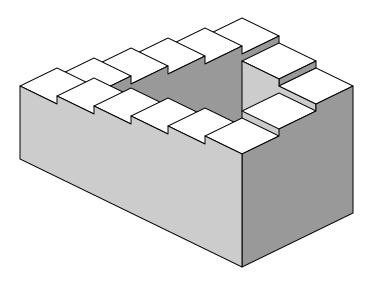
I also found it very interesting how you can have impossible figures. When the local depth cues are all fine, even if the laws of physics are defied, your brain interprets the information it receives to be alright. For example, this image shows a staircase that could never exist in real life. However, our brain only sees the small parts of the image our eyes are focused on, and as long as those look ok, the brain assumes the whole image is ok. Becuase our vision only checks exactly where we are looking rather than the whole image, the image as a whole can be impossible but be perceived as ok by the brain.

I also found it very interesting how you can have impossible figures. When the local depth cues are all fine, even if the laws of physics are defied, your brain interprets the information it receives to be alright. For example, this image shows a staircase that could never exist in real life. However, our brain only sees the small parts of the image our eyes are focused on, and as long as those look ok, the brain assumes the whole image is ok. Becuase our vision only checks exactly where we are looking rather than the whole image, the image as a whole can be impossible but be perceived as ok by the brain.
Thursday, February 12, 2009
Comments on: Cherryl Broverman's Lecture and Women's Empowerment through Information Technology
I thought Broverman's lecture did a great job of presenting the interesting fact that even while Kenya is a very poor country, many males Kenyans have access to (almost) modern day technology. While most villages don't have running water or bathrooms, they do have internet cafes, and many males Kenyans have cell phones. However, Broverman, as well as the articles, also presented the idea that impoverished women in the countries of Africa don't have any education, gender equality, or access to technology. Ms. Broverman talked about how the WISER initiative is hoping to change this by directly bringing technology to women in Africa, to allow them to learn about AIDS and general health, the politics of their countries, women's rights movements throughout the world, or anything else they can find on the net. In this way, WISER's goal is to educate these women despite a culture that says women are meant to be wives and houseworkers.
Kiva.com, talked about during the lecture, also seems very interesting. It seems like a great way of helping people in Africa make big steps in their lives, while only having to contribute a small amount of money. This is becuase the level of wealth is so much different in the US than in Africa that a little american money is a lot of African value. To me, it seems more like community service to donate this money -- I don't know how many people really want a return on their loans instead of just to help someone in need.
I also thought Broverman's description of the ISIS 200 capstone project was very interesting. The students of this class are working on creating a toolkit to map pictures and places, and people's lives to system sort of like Google Earth, where the region can be explored on the macro level as a map and icons representing picture and events can be clicked on. Its very cool to see students from North Carolina are working to solve a problem half way across the world. I would very much like to see the finished product and how it is actually put to use to analyze different cultural aspects of Africa.
WISER Website Review
After reviewing the WISER website, I have come to some conclusions about its mission and the way it will go about fulfilling this mission. I think WISER's mission to "break the cycle of early marriage, HIV, and poverty" in Nyanza is a very important mission that could greatly help the citizens of Nyanza, and maybe eventually all of Africa. At the same time, the way to fulfill this mission could prove difficult. In an idealistic world, I think it is a great idea to open a school specifically for young women to educate them about micro-finance, technology, health, and politics. However, I think in reality it will be harder than this. For one, becuase of the masculine domination that currently exists in Nyanza, a lot of these girls' fathers will make there daughters stay home and do chores rather than (in their eyes) waste their time at a school for all girls, which, becuase of culture, the Nyanzian men would probably consider a joke. Also, even with 70% scholarships, that means 30% of students would have to find their own way to raise the money (perhaps with Kiva.com). In a country this impoverished, I think it would be hard for the girls to find the money to go to this school. For these reasons, I think WISER's idea is good, but I am skeptical of how well it will play out in reality.
SLURL Reviews
Interesting SLURLS (Visited by me and Dianhao Luo):
Visit Mexico (http://slurl.com/secondlife/Visit%20Mexico/132/60/62) - This island is a historical depiction of the Mayan Temples in Mexico. You can explore the Mayan temples, walk through the rain forest, or even take a zipline ride through the forest. It was really cool to explore, but there wasn't really anyone else here to talk to.
The Free Dove (http://slurl.com/secondlife/Gallii/113/53/33) - This island offers free accessories such as jewelry, hats, shoes, and tattoos to new players with no money. There was lots of free stuff to get and try on, and a bunch of new players were there to meet. This island was very welcoming towards new players, and seemed designed to appeal to new players via free stuff.
777 League (http://slurl.com/secondlife/2raw/117/92/22) - This island contains a community for virtual racing that includes one of the longest, most elaborate racing tracks in Second Life. They also have tons of really cool looking cars to buy (if you have the money, that is). While this island is open, you can't really participate unless you pay the 777 League around $10 US to buy a car. Without a car, you can watch, but not drive.
Tuesday, February 10, 2009
Information Science, Medicine, and Mr. Olson's Lecture
This weeks articles and Mr. Olson's lecture on the intersection of information science and medicine were very interesting. I think it's very cool how robots are being created to slowly but surely take the place of humans, such as Da vinci, a robot that allows surgeon's to more precisely and from anywhere in the world do surgery, Penelope, a robotic nurse, and, Dr. McSleepy, a robotic anesthesiologist who can interpret data on human blood-gas levels much quicker and more accurately than humans can. The question is, however, as we are able to assign these robots more and more tasks regarding surgery and health, should we? There is something very important in the difference between humans and robots -- we have the ability to think on our feet. For example, if something doesn't go as planned (or according to the algorithm in the case of a robot), a robot could just sit there and watch the person die becuase it doesn't have code on what to do in this new situation. However, a human has actual knowledge, rather than only directions, and so can imply what to do in those kinds of situations. There are also other issues regarding the dependability of "surgeon" robots. They could malfunction or physically break mid-surgery, for example. Also, I'm sure these robots use a huge amount of electricity to power themselves. If a natural disaster were to occur, many people would need hospital treatment, and there is a high likelihood that the power would go out so these robots wouldn't work. This means that during the times we need surgeons, nurses, ect. the most (when many people are injured at once), these robots would be unable to do their task. This would make natural disasters much worse, becuase all hospitals relying on these robots would be out of commission. Don't get me wrong, I do think the technology is useful. But becuase we are dealing with something as delicate as human life, I think this technology needs to be an additional tool of surgeons, not a replacement for them.
Tuesday, February 3, 2009
Comments on: Patrick Herron's Lecture
I thought today's lecture by Patrick Herron on Serious Games was very interesting. Not only did he clear up the irony I stated about Virtual Heroes by saying that they are looking to apply their technology to peaceful, not warlike, things, but he also defined simulation and how it is being used in the real world. He discussed flight simulators, network simulators, weather simulators, MMORPGs as simulations, and even the real world as a simulation. I really liked his point about how the real world could just be a simulation, like in the Matrix, and in reality we are simply "brains in the vat." Thinking of the real world as a possible simulation makes it even clearer how useful simulations can be. He even talked about how we learn faster through imitating/doing rather than simply being instructed on how to do something, and how becuase of this, using simulations lead to faster learning.
Saturday, January 31, 2009
Comments on: Virtual Peace
I think it is an interesting idea to use simulation technology to teach cooperation to resolve conflicts. However, I am skeptical of how useful Virtual Peace is/will be. For one, while Virtual Peace does have a fair degree of immersion due to voice chat, emotion animations, and real-time MMO style collaboration, as I said before in an earlier post, the game-like graphics to detract from Virtual Peace's goal. I think this tool does a great job simulating the difficulties in resolving large scale conflicts among multiple parties, all with different motives, but it may fall short in the teaching aspect becuase at the end of the simulation, many users may just remember it as "a game" due to the video game graphics and style of play. Another reason I have for being skeptical of this technology is becuase its creators, Virtual Heroes, are very hypocritical. They are, of course, brilliant for developing this technology, but another one of their simulation games they created, "America's Army," serves to do the exact opposite of creating peace. I think this fact will give users of Virtual Peace a harder time taking what they get out of the simulation seriously, knowing the simulation's creators also made a war game. I do think the idea is a good one, but we need to develop technology, and our motives, more before simulations like this can be fully appreciated.
Wednesday, January 28, 2009
Comments on: Google Earth
Google Earth helps fulfill the version of the Metaverse becuase it provides a 2-D view of the entire globe, and presents various types of other information on many, many places. Some other types of information are 3-D views of buildings and terrain, labels of countries, regions, cities, buildings, businesses, and terrain formations, and wikipedia-esce information on many, many points of interest. Not only does it provide this information, but it lets you search the globe, moving forward or backward, left or right, zooming in or out, or panning your view up or down, left and right. It even has a search tool that lets you search for businesses, points of interest, and specific addresses. You can even get directions using Google Earth.
By combining this with Second Life, we could create a virtue universe (metaverse) the directly reflects the real one. In other words, people who own a building in real life would own the building in Second Life. For example, every store in the real world could have a second life account that owns their store in Second Life. In the Second Life store, they could advertise for the goods and services they sell in real life. While this is a cool idea, I don't think it will play out. As I said in my last post, 3D navigation of information is harder and slower than 2D navigation (the current internet). For example, it may be cool to fly through Google Earth to the pyramids and read information on them, you could get more information faster using the Internet. Also, becuase of its game-like graphics, I don't really take any current businesses on Second Life, that either sell virtual goods or advertise for a real life company, seriuosly becuase their structures and avatars look like they are from video games for kids, not professional.
By combining this with Second Life, we could create a virtue universe (metaverse) the directly reflects the real one. In other words, people who own a building in real life would own the building in Second Life. For example, every store in the real world could have a second life account that owns their store in Second Life. In the Second Life store, they could advertise for the goods and services they sell in real life. While this is a cool idea, I don't think it will play out. As I said in my last post, 3D navigation of information is harder and slower than 2D navigation (the current internet). For example, it may be cool to fly through Google Earth to the pyramids and read information on them, you could get more information faster using the Internet. Also, becuase of its game-like graphics, I don't really take any current businesses on Second Life, that either sell virtual goods or advertise for a real life company, seriuosly becuase their structures and avatars look like they are from video games for kids, not professional.
Tuesday, January 27, 2009
Comments on: Second Life/Metaverse Readings and Lecture
I thought the readings, and especially the guest lecture, about second life and the metaverse were very interesting. I really like the speaker's overview of how GUIs have evolved over the last 40 years, and his introduction on how they will evolve in the future. The Cobalt/Croquet 3-D Internet project he showed us a video of was really cool, although I don't know how important/applicable it really is. While a peer-to-peer version of the Internet would be more efficient and would stay connected and updated better, I just don't see the need for a 3-D interface when a 2-D one can do all the same things. The 3D interface where more than one person occupy a "world" at the same time adds a lot of needless information, clutter, and removes anonymity. Also, it is much harder to navigate to the information you want in 3-D than in 2-D -- there's a whole 'nother dimension to navigate. This is plainly visible in Second Life, which has tons of needless information and clutter (much of it adult oriented). And as for the argument that 3-D Internet would be good for group collaboration becuase you can discuss in a 3-D environment when "everyone" (everyone's avatars) are present, I just don't see why 3-D makes this any better. You can already have these collaborative efforts or virtual classrooms over chat rooms in the current 2-D Internet. You can even make them more face to face than with avatars by using webcams.
As for companies that "have investigated the potential and started to develop virtual landscapes that promote their compan[ies]," I have visited some of these landscapes in Second Life, and don't feel very inclined to buy their products. I feel that people who were interested in buying these products would either go to the real-life location, or view its easily-navigated, 2-D website if they wanted more information on them. This may just be me, but it seems like virtual worlds, especially Second Life, are predominately inhabited by people who aren't sociable in real life and just want the anonymity so they can feel more sociable, or they want to engage in the gigantic adult industry market on Second Life, which to me seems to be the equivalent of a giant, anonymous, nerd orgy. These people arn't interested in learning about your products, they just want virtual friendship and/or virtual sex. If you think I'm wrong in assuming Second Life is dominated by sex, read this article. Quote: "Of the 19 popular destination icons on my map, 9 of them were virtual pornography accounting for more 51% of the total population listed for popular locations in Second Life."
As for companies that "have investigated the potential and started to develop virtual landscapes that promote their compan[ies]," I have visited some of these landscapes in Second Life, and don't feel very inclined to buy their products. I feel that people who were interested in buying these products would either go to the real-life location, or view its easily-navigated, 2-D website if they wanted more information on them. This may just be me, but it seems like virtual worlds, especially Second Life, are predominately inhabited by people who aren't sociable in real life and just want the anonymity so they can feel more sociable, or they want to engage in the gigantic adult industry market on Second Life, which to me seems to be the equivalent of a giant, anonymous, nerd orgy. These people arn't interested in learning about your products, they just want virtual friendship and/or virtual sex. If you think I'm wrong in assuming Second Life is dominated by sex, read this article. Quote: "Of the 19 popular destination icons on my map, 9 of them were virtual pornography accounting for more 51% of the total population listed for popular locations in Second Life."
Second Life: Initial Exploration
After making an account and entering the metaverse, the first place I went was the ISIS 100 Oasis. The Oasis is filled with weird and interesting objects, such as 6 big flamingos and one giant flamingo. There is also a "Welcome To China" sign. Some of the areas that I want to explore, like a basketball court with a giant pumpkin in the middle, I can't access, however. They say "No entry" around them. Upon getting to the oasis, I met the avatar of Nitin Gupta (DukeNG Bouscario), I friended him, and we explored the oasis. We learned to use the gesture commands and messed around with them.
After that, I went to "The U'Bar," a "bar" where people relax, dance and listen to music. They had live radio playing. Many people were there dancing, and the dance floor was covered with bright laser lights and advertisements for guiness. Someone offered to "animate" me. I agreed and this made my avatar dance. I could not figure out how to stop dancing, but when I teleported I lost the urge to boogie. The SLURL for The U'Bar is http://slurl.com/secondlife/Lusiana/117/197/3001
I also went to "Fiat Latino America," the official Second Life island of the Fiat car company. The island has many cool rooms, a virtual attendant, and a showcase room for all the cars it sells in real life. In the showcase room, each car model has a 3D representation of it that looks very similar, as well as a description of the car. This is a large island meant to advertise for the Fiat car-manufacturing company. Fiat Latino America's SLURL is http://slurl.com/secondlife/FIAT%20LATINO%20AMERICA/128/128/27
Lastly, I visited PlantPets. The plant pets project is a project within Second Life to create interactive, growing plants. PlantPets grow and express happiness the more you take care of them. The place was a store that sold these plants, but I won a prize and received a free one. I don't know where/have a place to plant it though! The SLURL for the PlantPets store is http://slurl.com/secondlife/Plush%20Kappa/84/228/22
Tuesday, January 20, 2009
My Wikipedia Entry
I edited the article on Greek and Social Life on the Duke University page on Wikipedia. I added the section in the first paragraph on Selective Living Groups.
Here's the link.
Here's the link.
Comments on Paolo Mangiofico's Presentation
I enjoyed Mangiofico's presentation today on the social life of information. His lecture shared many parallels with Shirky's article, "Ontology is Overrated." Both talked about direct contribution from users to share and gain information over the web, and how user generated information is better than categorization by the owners of the website. For example, Mangiofico mentioned that many university catalogs pay LibraryThing money to have their records linked to LibraryThing's records. This allows the university catalogs to have better dynamic social data about their books. One example of this is that while on the university catalog books typically only have a few subjects, LibraryThing's users provide much more informative tags on the many topics of each book. Linking to LibraryThing's content allows the university catalog to take advantage of this information.
I particularly enjoyed that Mangiofico showed us some of the technologies he was speaking about, Delicious, CiteULike, WorldCat, and LibraryThing. These websites are all based on user added content to enact their purpose. However, each sight has its own purpose. Delicious is used to share/bookmark/tag websites the user finds interesting. CiteULike is like Delicious, but for research papers rather than websites. WorldCat is an online category of libraries' information, and LibraryThing is the Delicious of books. One nifty thing Mangiofico showed us about WorldCat was that WorldCat's search sorted by "relevance" rates books depending on which books, journals, etc. are owned by the most libraries, and therefore are the most valued. He compared this with Duke Library's own catalog search system, which returned far less relevant results.
I particularly enjoyed that Mangiofico showed us some of the technologies he was speaking about, Delicious, CiteULike, WorldCat, and LibraryThing. These websites are all based on user added content to enact their purpose. However, each sight has its own purpose. Delicious is used to share/bookmark/tag websites the user finds interesting. CiteULike is like Delicious, but for research papers rather than websites. WorldCat is an online category of libraries' information, and LibraryThing is the Delicious of books. One nifty thing Mangiofico showed us about WorldCat was that WorldCat's search sorted by "relevance" rates books depending on which books, journals, etc. are owned by the most libraries, and therefore are the most valued. He compared this with Duke Library's own catalog search system, which returned far less relevant results.
Sunday, January 18, 2009
Comments on: Ontology is Overrated by Clay Shirky
I found Shirky's article on classification and categorization very interesting. In particular, however, I enjoyed reading about non-classification, as well as user-classification and tag relation. It makes sense that uses would rather use Google's search engine than Yahoo's structured framework for browsing. Many obsucre things, like, as Shirky points out, "obstreperous Minnesota," would be hard to find and classify in a rigid categorized system, but would be easy to find on a search engine that works on keywords and what websites other people interested in "obstreperous Minnesota" visited. Also, people like to be free to create their own categorizations, they don't want to be constrained to how Yahoo categorizes reality.
This leads into the second part of the article that really interests me, user tags to classify information. Instead of Yahoo's system of building the categorization system and then adding websites where they fit, tagging is dynamic. When a user tags a website they visited with certain keywords specific to that exact webpage, those keywords can be any (and any amount of) word(s) in the dictionary. This breaks free of the rigid classification system and allows for an ever changing dynamic system where pages are linked by these tags. Another part of this I found interesting is how sites like del.ico.us link keywords that may be synonyms based if many users gave websites the same tags. As Shirky puts it, "A lot of users tagging things foobar are also tagging them frobnitz. I'll tell the user foobar and frobnitz are related." In doing so, these sites are categorizing based off their users', rather than their own, views of reality.
This leads into the second part of the article that really interests me, user tags to classify information. Instead of Yahoo's system of building the categorization system and then adding websites where they fit, tagging is dynamic. When a user tags a website they visited with certain keywords specific to that exact webpage, those keywords can be any (and any amount of) word(s) in the dictionary. This breaks free of the rigid classification system and allows for an ever changing dynamic system where pages are linked by these tags. Another part of this I found interesting is how sites like del.ico.us link keywords that may be synonyms based if many users gave websites the same tags. As Shirky puts it, "A lot of users tagging things foobar are also tagging them frobnitz. I'll tell the user foobar and frobnitz are related." In doing so, these sites are categorizing based off their users', rather than their own, views of reality.
Tuesday, January 13, 2009
Comments on: Video Games as Community Building Tool by Omar Gallaga (NPR)
This story is about how video games are becoming less "hardcore"and more of a social activity. The article cites Nintendo, whose casual games have created a "living room Renaissance of social gaming" by lowering the learning curve and creating games that require less time of the players to get in to, and less effort to enjoy. This makes the games more accessible, easier to pick up and play when you have less time, or more friends, on your hands. For example, instead of beating bosses or solving complex puzzles, you simply have to swing your arms to hit a baseball (or pitch a baseball to your friend) in Wii Sports. These games focus more on beating your opponents at simple tasks rather than at using complex button sequences, making them more fun to play as a group.
The article also cites social interaction through games online. If you don't have any friends around one day, you can always sign into these games online (more so on the Xbox 360 and Playstation 3 than Nintendo's Wii), where you can compete against other human players anywhere in the world. You can even communicate over headsets to talk in real time to your opponents and team mates.
Reading similar articles provides even more information on the topic. Article 1 looks at how the industry is currently shifting from creating games that appeal to a "small cadre of tech-savvy youngsters" to the broad public, similar to the style of the Nintendo Wii. Through creating games for families, adults, and women rather than only for young males, almost all people can find something they like, creating a much larger social network for gaming in general. As more of these social games are created, there will be more temptation to play these games in groups rather than solo.
Article 2 discusses how Massively Multiplayer Online games promote "sociability" and the adaptation to "new world views." By creating a social bridge between different peoples around the world, each individual is exposed to a diversity of world views. With an MMO network 9 million people strong, and the average user spending 20 hours a week playing an MMO, players are able to meet, interact, and learn the views of countless other players. And, unlike the real world, geographic locations in MMOs don't de facto contain individuals of mostly the same views. D.C. is overwhelmingly democratic, Texas is overwhelming republican, but "Freeport" in Everquest contains people with diverse views becuase it can be accessed from any real world geographical location over the net.
Click here to listen to the original story.
Similar articles:
Article 1) http://www.nytimes.com/2008/02/28/arts/television/28game.html
Article 2) http://news.illinois.edu/NEWS/06/0816videogames.html
Monday, January 12, 2009
Comments on: The Polarization of Extremes by Cass R. Sunstein
I found this article to be much more objective and informative than the Facebook article. The author does a great job of showing how the Web pushes people to become more extreme in their views. The author states that people tend to read articles or join communities on the Web that reinforce their current liberal/conservative views on certain issues. However, this polarization is not unique to the Internet. The Web only acts as a catalyst for this type of interaction. For example, off the computer, people tend to choose friends who have similar views to them (like they choose to read websites with similar views to them). By doing so, people surround themselves with friends who have the same views, some with even more extreme views. Just as the net leads to polarization to extremes, so do these groups of friends. The more they talk about their shared views, the more they believe their views are correct. This polarization is the same as the Web's, but the Web allows people to find these "friends," which in this case are websites and online communities, quicker and easier.
Friday, January 9, 2009
Comments on: How Your Creepy Ex-Co-Workers Will Kill Facebook by Cory Doctorow
While I found this article interesting, I disagree with a few points. Facebook is a valuable tool that allows friends physically separated to easily communicate. The article characterizes Facebook as "pimping" us, but much evidence is to the contrary. Facebook doesn't force the user to display information, upload pictures, join groups, or be friends with anyone. It doesn't even force you to show your profile to people in your specified network. If Facebook is a 'pimp,' its the most lienient pimp I've ever seen. The only policing Facebook does is limit the uploading of copyright information and making users remove inappropriate pictures.
The articles information isn't even accurate. Doctorow states, "The clue is in the steady stream of e-mails you get from Facebook: “So-and-so has sent you a message.” Yeah, what is it? Facebook isn’t telling—you have to visit Facebook to find out, generat[ing] a banner impression." This is not the case. Facebook's emails not only tell you a friend has written to you, but also display the actual message in the email. There no need to visit the site.
The author goes on to complain about his friend requests from "a guy who beat me up on a weekly basis through the whole seventh grade" and "the crazy person who was fun in college but is now kind of sad." The solution is simple. If you don't want them to be able to interact with you, don't friend them. This equates to blaming a high school reunion for allowing a past schoolmate to say hi to you. Facebook doesn't create akward situations, they occur in real life and so will exist on Facebook too. "It’s socially awkward to refuse to add someone to your friends list—but removing someone from your friends list is practically a declaration of war." If you don't want them as a friend, why do you care what they think anyway?
To conclude, the author says, "As more users flock to it, the chances that the person who precipitates your exodus will find you increase. Once that happens, poof, away you go—and Facebook joins SixDegrees, Friendster, and their pals on the scrapheap of Net.history." Or, you could just not friend them. It's ridiculous to blame a social network for allowing a social contact to find you. That's its purpose.
About Me
Hey guys, my name is Joe Levy and I'm in Duke's ISIS 100 class. I was born in Boston, but moved to Washington D.C. when I was four years old. I hope to major in Computer Science and get certificates in ISIS and Markets and Management. My interest in computers and information technology probably comes from my father, who is an IT consultant. From a young age, he taught me many interesting things that computer can do. Eventually, I started exploring computers on my own.
I'm not just interested in computers though. I'm also very into sports. In high school, I wrestled for 4 years, and I'm a huge fan of Duke Basketball. I'm in a tent in K-Ville most nights of the week. Stop by and say hi!
I'm not just interested in computers though. I'm also very into sports. In high school, I wrestled for 4 years, and I'm a huge fan of Duke Basketball. I'm in a tent in K-Ville most nights of the week. Stop by and say hi!
Subscribe to:
Posts (Atom)